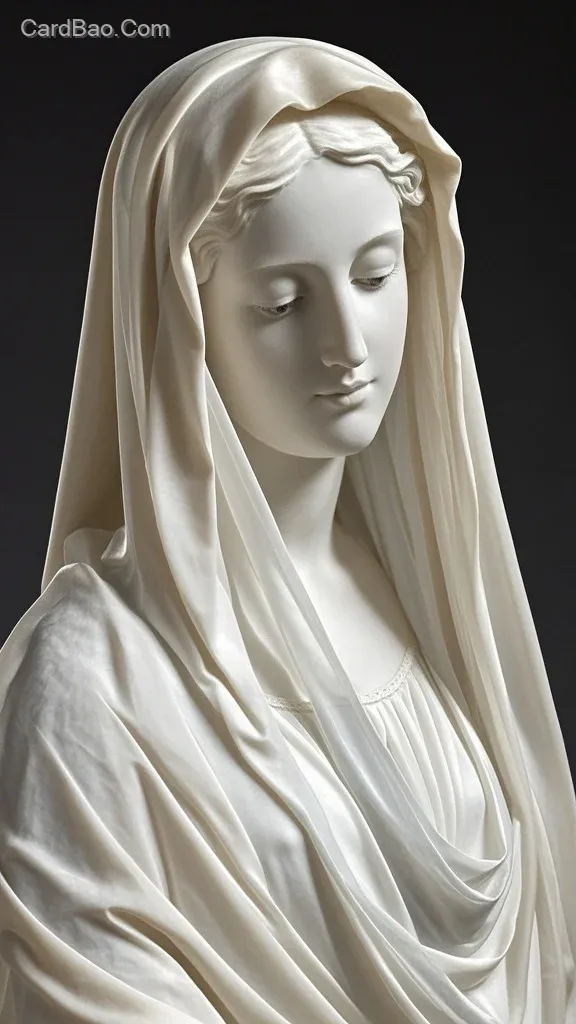
Madonna of the Veil in Marble: The Pinnacle of 19th-Century Sculpture
大理石面纱圣母:19世纪雕塑巅峰
English Prompt:
The Veiled Virgin, also known as the "Blue Lotus," was created in 19th-century Milan, Italy, and is carved from a single block of high-quality pure white marble. The Virgin Mary is depicted covered by a veil, whose delicate texture and realistic effect deliver an immediate emotional impact, evoking a sense of awe that can make one's skin tingle.

Legend has it that after its completion, the sculpture was privately collected by a bishop who cherished it deeply. It remained out of public view until recent years, when it was finally unveiled during an exhibition.

It is said that the bishop wrote in his diary: "Received a beautiful marble statue of the Virgin Mary from Rome, veiled, with her form and features subtly revealed. It is a perfect artistic treasure."

This marble sculpture, created by Giovanni Strazza, is considered a masterpiece of 19th-century sculptural art. Marble is a hard material, resistant to chiseling and cutting, yet in this work, it appears flexible and light, creating a paradox.

However, Giovanni Strazza gradually reduced the stone, skillfully carving the surface to achieve a delicate texture that seems to convey the softness and smoothness of the veil.

The translucent effect of the veil is not achieved through traditional transparent techniques but through the interplay of light, shadow, and intricate details, creating an atmosphere where illusion and reality intertwine. The varying thicknesses of the veil create a sense of movement and fluctuation, blurring the overall image.

In my view, people are so captivated by this work because it embodies the paradox between strength and fragility, as well as the ambiguity between purity and sensuality.

The facial expression of the Virgin Mary is equally moving. Her closed eyes symbolize spirituality, and her face conveys a suppressed emotion, with her head bowed as if immersed in deep thought or prayer.

Through masterful facial carving, Strazza vividly expresses the Virgin’s serenity and composure, making this sculpture not only a challenge to artistic skill but also a profound expression of faith and emotion.

The Virgin’s demeanor and posture reflect both her piety and her tenderness and strength as a mother, which is highly characteristic of the 18th-century Neapolitan tradition in Italy. This tradition emphasizes the skillful carving of marble to reveal the dual nature of concealment and exposure in human facial features.

From an archaeological perspective, this technique originates from the "wet drapery" style.

The hallmark of this style is the depiction of fabric as if it were wet or clinging tightly to the body. Through meticulous carving, the artist renders the folds of the fabric in a way that outlines the contours of the body beneath, creating
中文Prompt:
蓝莲花这件面纱圣女诞生于19世纪意大利的米兰,使用一块完整的高品质的纯白大理石制作而成。圣母玛利亚被面纱覆盖,面纱轻盈的质感与逼真的效果能够在一瞬间给予我们心灵上的冲击,让人看的鸡皮疙瘩都要起来了。
传说在作品完成之后,面纱圣女被一位主教私人收藏,并对他呵护有加。直到近些年才因为一场展览而得以公之于众。
据说,这位主教在自己的日记中写道:从罗马收到一座美丽的大理石圣母玛利亚雕像,面纱覆盖,身形和五官若隐若现,他是完美的艺术瑰宝。
这件由乔瓦尼斯特拉扎创作的大理石雕塑堪称19世纪雕塑艺术的巅峰之作。大理石是一种坚硬的材料,既抗凿也抗切割,而在这件作品中,他似乎变得灵活且轻盈,创造了一种悖论。
但是乔瓦尼斯特拉扎却在这块硬质石材上逐渐消减石材,让雕塑的表面呈现出细腻的质感,仿佛能触摸到面纱的柔软与光滑。
面纱部分的透明效果并非通过传统的透明手法,而是通过雕刻的光影与细节,营造出一种虚幻与真实交织的氛围。面纱的不同厚度层次似乎让人产生一种波动感,运动感,模糊了整个形象。
在我看来,人们之所以对这件作品如此着迷,是因为他聚集了所有力量与脆弱之间的悖论,纯洁与感官之间的模糊。
圣母玛利亚的面部表情同样令人动容,他闭着的眼睛代表了灵性,圣母的面容传达出一种压抑的情感,低着头,似乎正沉浸在某种深沉的思考或祈祷中。
斯特拉扎通过巧妙的面部雕刻,将圣母的宁静与沉稳表现的淋漓尽致,使得这座雕塑不仅是对艺术技巧的挑战,更是对信仰和情感的深刻表达。
圣母的神态和姿态既体现了她的虔诚,也展现了她作为母亲的温柔和力量,这非常具有18世纪意大利那不勒斯的传统特色,这一传统注重巧妙的雕刻大理石完为人类面部隐藏与暴露的双重特征。
从考古学的角度来看,它源于湿袍wet drapery系法。
这一系法的特点是将布料表现得如同湿透或者紧贴身体,通过精雕细琢,艺术家将布料的褶皱雕刻的仿佛展示出其下方身体的轮廓,创造
Resolution: 576×1024